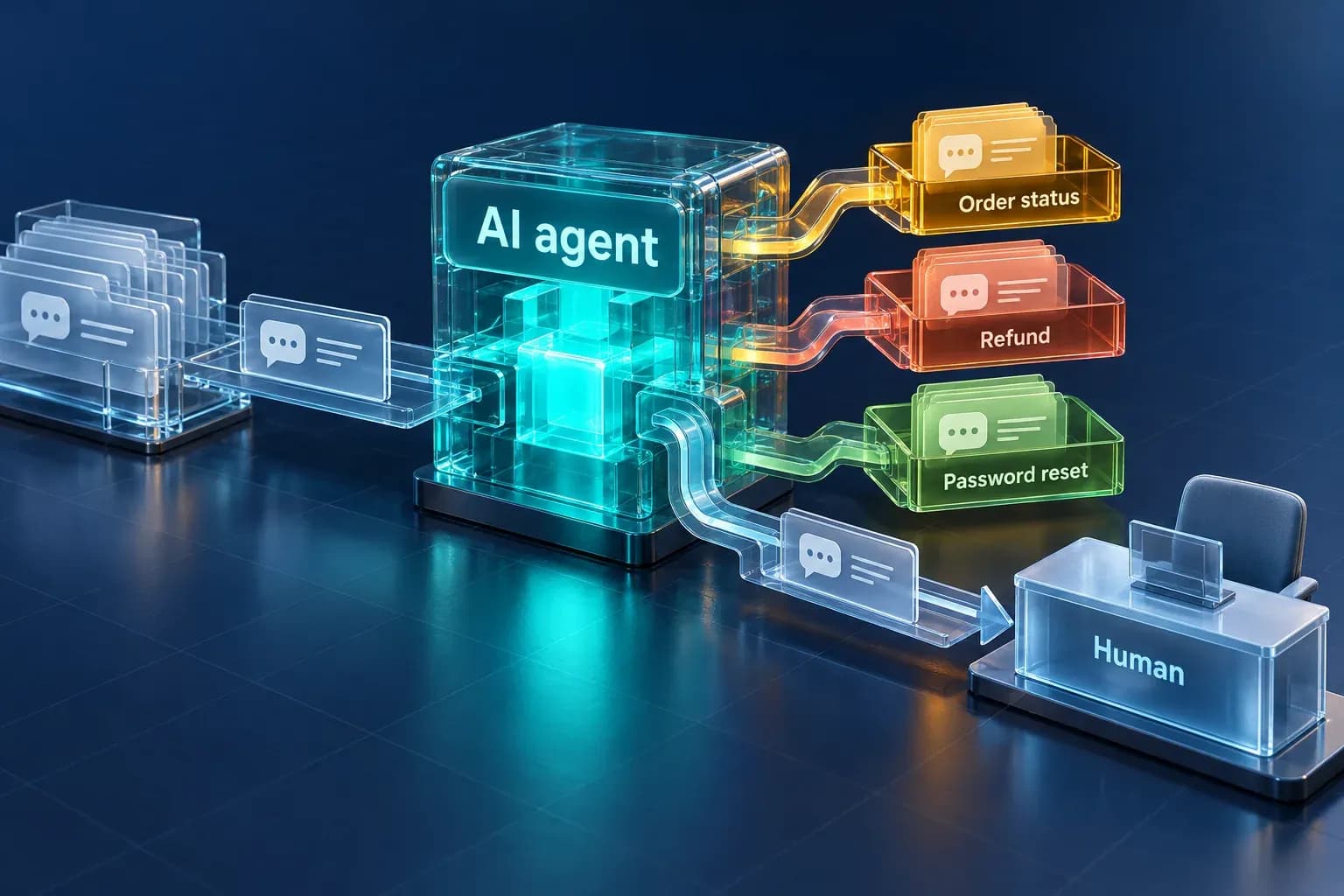
Automated service used to mean a phone tree and a canned reply. Today it means something closer to a colleague: software that reads a request, decides what it actually needs, and either resolves it on the spot or routes it to a person with the context already attached. That shift, from scripted responses to judgment, is what separates a real automated service system from the rule-based tools that came before it.
What "Automated Service" Actually Means
Automated service is any support process where a system, not a person, handles the request from intake to resolution or escalation. The scripted version has existed for years: a chatbot that matches keywords to canned answers, an IVR that routes by menu selection, a macro that fires when a ticket contains a certain word. That version is fast and cheap, and it breaks the moment a request does not match its rules.
The newer version runs on AI agents instead of fixed rules. An agent reads the request as written, checks the relevant system, an order, an account, a policy, and decides which of several paths applies, then acts: issuing a refund within a defined limit, updating a record, replying with an accurate answer pulled from the actual account state, or handing the case to a person when it falls outside what the agent is allowed to resolve alone. The distinction that matters for evaluating any automated service claim is simple: does the system only match patterns, or does it make a decision and act on it.
Rule-Based Automation vs. AI Agents in Customer Service
Four differences decide which one is actually running underneath a vendor's "automated service" claim:
- Input it handles. Rule-based automation needs structured, predictable phrasing. An AI agent reads unstructured requests, free text included.
- What happens on a new case type. Rule-based automation fails or routes to a queue. An AI agent classifies it and decides a path.
- How it changes. Rule-based automation requires reprogramming the rule. An AI agent improves as the underlying model improves.
- Best fit. Rule-based automation suits high-volume, single-format requests. An AI agent suits multi-step cases with real variation.
Both have a place. A password-reset flow that always follows the same three steps does not need judgment, it needs speed, and rule-based automation is still the right tool for it. The cases worth automating with an agent are the ones with a real decision inside them: which refund policy applies, whether an account is eligible for an exception, what the right next step is when a shipment shows delayed instead of delivered.
What AI Agents Can Handle Without a Person
The narrow, well-bounded version of automated service is what actually reaches production, not the broad claim of "automating support." In practice that looks like:
- Order and account status. Checking a live system and giving an accurate answer instead of a generic one, closing the loop without a ticket ever reaching a queue.
- Standard resolutions within a defined limit. A refund, a credit, or a replacement under a dollar or policy threshold the business has already set.
- Routing with context attached. When a case does need a person, arriving with the account already checked and the relevant history summarized, instead of a bare message.
- Follow-up and closure. Confirming a resolution, updating the record, and closing the case once the action is complete.
What stays with a person is anything sensitive, irreversible, or outside the agent's defined authority: a dispute, a complaint about the company itself, an exception to a policy nobody has pre-approved, or any request where getting it wrong has a real cost. A well-built automated service system is explicit about that boundary rather than leaving it implicit.
Where a Human Still Has to Be in the Loop
The risk in automated service is not that an agent handles the easy cases. It is an agent quietly handling a case it should not have, with no record of why. Governed AI agents need approval queues and audit trails for exactly this reason: every sensitive action should be reviewable before or immediately after it executes, and every action an agent takes should leave a record of what it did, which system it touched, and why.
That governance layer is what turns "the AI handled it" from a liability into something a compliance team can actually sign off on. It is also what makes the automation trustworthy enough to expand: teams that can see the approval boundary and the audit trail hand more real work to the system over time, not less.
What to Look For When Evaluating an Automated Service Vendor
A short list worth checking before any automated service tool touches a live account:
- Can you see the approval boundary? A vendor should be able to show exactly which actions execute automatically and which require sign-off, and let a business change that boundary itself.
- Is there an audit trail for every action, not just the final result? If the system issues a refund or updates a record, there should be a retrievable record of the decision path.
- Does it handle exceptions, or just the happy path? Ask what happens when the input falls outside the expected case, not only how it performs in a demo.
- Where does the system run, and what happens to the data? Deployment options and data-handling terms should be answered directly, not buried in a sales deck.
- Does the vendor stay to operate it, or hand it over after launch? Most AI consulting stops at strategy. The harder and more useful work is building the production system, governing it, and staying to operate it.
Archon Agents is a managed AI operations company: we build and operate governed AI workforces for organizations that need real execution, not another tool to manage. Archon Workforce runs six specialist agents under one orchestration layer, with the approval boundary and audit trail built in rather than bolted on, and deployment available on managed cloud, a private VPC, or fully on-premises depending on what a company's data policy requires. Customer prompts, files, outputs, and workspace data are not used to train foundation models. For the broader pattern this fits into, see what intelligent process automation actually adds over fixed rules and what a real business process automation engagement includes.
FAQ
Is automated customer service the same as a chatbot? Not necessarily. A chatbot that matches keywords to canned replies is rule-based automation. Automated service built on AI agents goes further: it reads the request, checks the relevant system, and decides what to do, which is a different capability than matching a pattern to a script.
Does automated service replace a support team? Not in a well-built system. The goal is a team that spends its time on the cases that need judgment, while routine, well-defined requests resolve without ever reaching a queue. Anything sensitive, irreversible, or outside a pre-approved policy still routes to a person.
What makes automated service safe to run unattended? A defined approval boundary and an audit trail. Routine, low-risk actions execute without a person; anything outside that boundary queues for review, with a record of what happened and why.
How is this different from basic workflow automation? Workflow automation follows a fixed path and breaks on anything it was not explicitly coded for. Automated service built on AI agents adds a judgment layer: it can classify a request it has not seen phrased exactly that way before and decide which path applies.
What should disqualify a vendor during evaluation? A system with no visible boundary on what it can do without a person, and no audit trail for what it already did. A vague answer to either question is itself the answer.
Most AI firms advise. Some sell tools. The organizations getting real value from automated service right now are the ones that treated it as an operations problem from the start: a defined scope, a defined approval boundary, and a system built to be governed rather than trusted blindly. Book a Consultation to talk through where automated service actually fits in your operation.