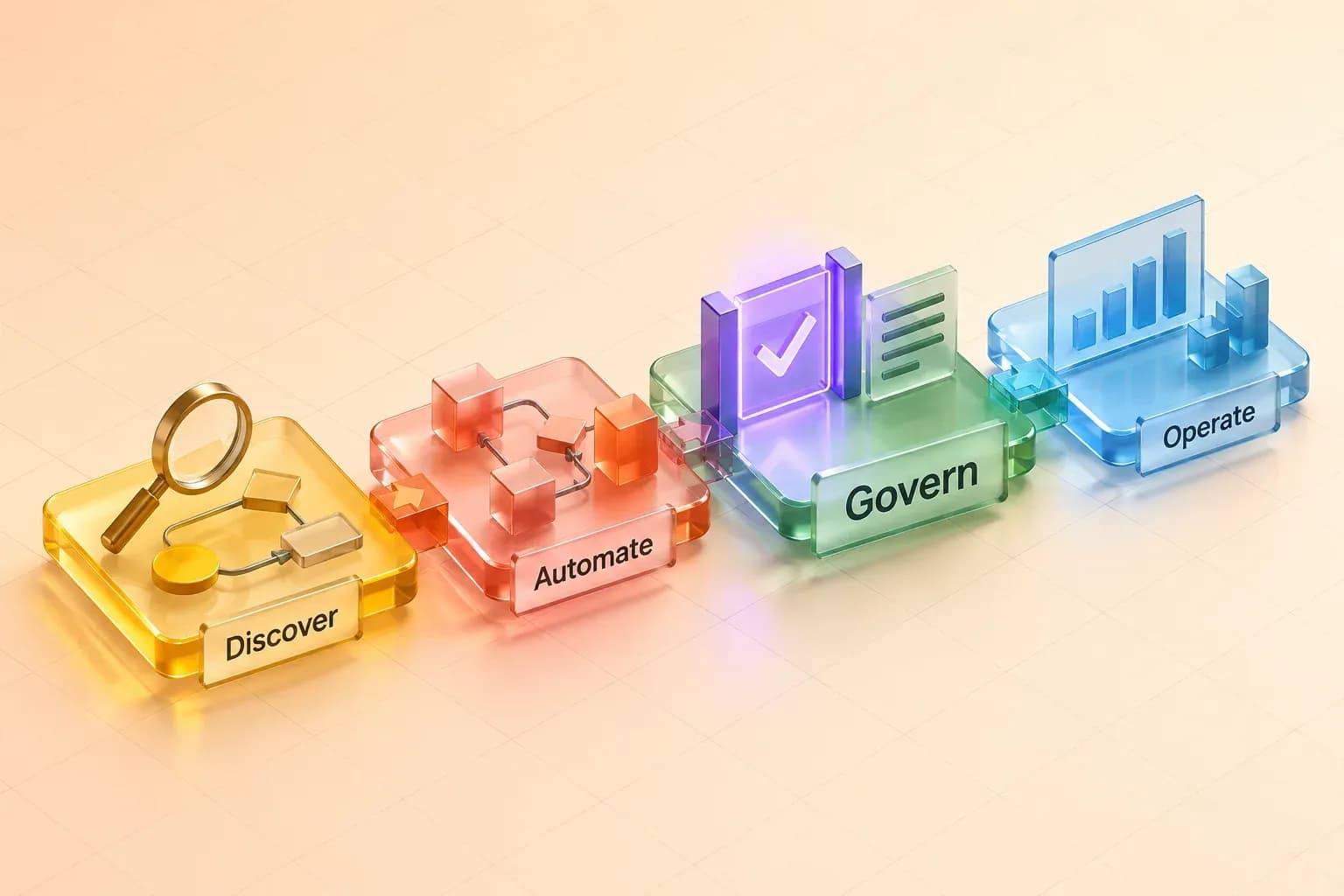
Business process automation services should deliver a working system, not a diagram of one: workflows mapped, exceptions routed, approvals tracked, and the process actually running with a person checking the decisions that need one. Here is what a real engagement includes, and where AI agents change what a "process automation" provider can take on.
What Business Process Automation Services Actually Include
The term covers more ground than a single tool purchase. A real engagement usually runs through five stages:
- Discovery, mapping the current process end to end: the systems it touches, the decision points, the exceptions that break the happy path.
- Design, defining what gets automated, what stays human, and where an approval sits before an action goes out.
- Build, the automation itself, whether that is rule-based robotic process automation (RPA) for stable, high-volume steps or an AI agent for steps that require judgment.
- Integration, connecting the automation to the systems of record it needs, with scoped, least-privilege access rather than broad standing credentials.
- Operation, the ongoing part most buyers underweight: monitoring, exception handling, and updating the automation as the underlying process changes.
A provider that stops at "build" has sold a script, not a service. The service is everything around the automation that keeps it running correctly after launch.
Where AI Agents Change the Scope of Automation
Traditional RPA is rule-based: it follows a fixed path and breaks the moment a case falls outside it. That is fine for a stable, high-volume, low-variance process, and it is still the right tool for plenty of work.
AI agents extend the scope by adding judgment to the automation itself. Instead of only executing a fixed path, an agent can classify an unstructured input, decide which path applies, pull context from more than one system, and route the exception to a person instead of failing silently. The process handles more of its own variance before a human has to step in.
For over a decade, the team behind Archon built Salesforce ecosystems, automation infrastructure, creative pipelines, reporting systems, and full-stack applications for companies across hospitality, entertainment, marketing, and enterprise, the RPA-and-integration work business process automation services have always covered. AI agents are the newer layer on top of that same discipline, not a replacement for it.
Most AI firms advise. Some sell tools. Archon operates the workforce.
How to Evaluate a Business Process Automation Services Provider
Four questions separate a governed engagement from a demo:
- How does it handle exceptions? Ask to see what happens when the input falls outside the expected case, not just the happy path.
- What is scoped, and what is standing access? Least-privilege access to only the systems the process needs is the baseline, not an upsell.
- What is the approval model? Any step that is sensitive, irreversible, or customer-facing should have a human checkpoint before it fires, with an audit trail behind it.
- How is it priced? A provider pricing around the scope of the work, not per seat or per token, is pricing for outcomes rather than usage, worth asking about directly since published rates change faster than a blog post can track them.
What a Governed Engagement Looks Like
Governance is not a compliance add-on bolted onto automation after the fact. It is what makes the automation safe to extend. A governed AI agent needs an approval queue and an audit trail the same way any employee handling sensitive work does: visibility into what ran, what it touched, and who signed off.
That is also the deployment question worth asking early. The Archon workforce runs on managed cloud, a private VPC, or fully on-premises, model-agnostic by design, and does not use customer prompts, files, outputs, or workspace data to train foundation models. Access runs through SSO, role-based access control, approval queues, and audit logs, the same controls a security team would expect from any system with production access, not a separate standard for "the AI part."
Most AI consulting stops at strategy. Business process automation services that are actually a service stay past the recommendation, building the production system, governing it, and operating it, which is the difference between output and access when a team is deciding what to buy. For teams weighing the broader build against a narrower automation project, our guide to AI workflow automation covers where the wider category pays off first.
The cluster this pillar sits under carries a few specific automation questions worth their own read: the case for robotic process automation, where workflow software stops and an agent workforce picks up, and what intelligent process automation actually adds over standard RPA.
Business Process Automation Services FAQ
What is included in business process automation services? Discovery, process design, the automation build (RPA, AI agents, or both), integration with existing systems, and ongoing operation: monitoring, exception handling, and updates as the process changes.
What's the difference between RPA and AI agent automation? RPA follows a fixed, rule-based path and works best on stable, high-volume steps. AI agents add judgment: they can classify unstructured input, decide which path applies, and handle more exceptions before a person needs to intervene.
How much do business process automation services cost? Pricing varies with scope, the number of processes involved, and whether ongoing operation is included. A provider pricing around scope of work rather than seats or tokens is worth asking about directly, since rates shift; see current pricing.
How long does implementation take? It depends on how many systems the process touches and how much of the exception-handling logic already exists on paper. Starting with one high-volume, well-understood process and extending from there is the faster path to a working system than a single big-bang rollout across every process at once.
Do these services replace an internal operations team? No. The goal is a governed system an operations team runs against, with clear ownership, approval checkpoints, and visibility, not a black box that removes the team from the loop.
Ready to see what a governed engagement looks like for your own processes? Book a Consultation and bring the process that is costing your team the most manual rework.