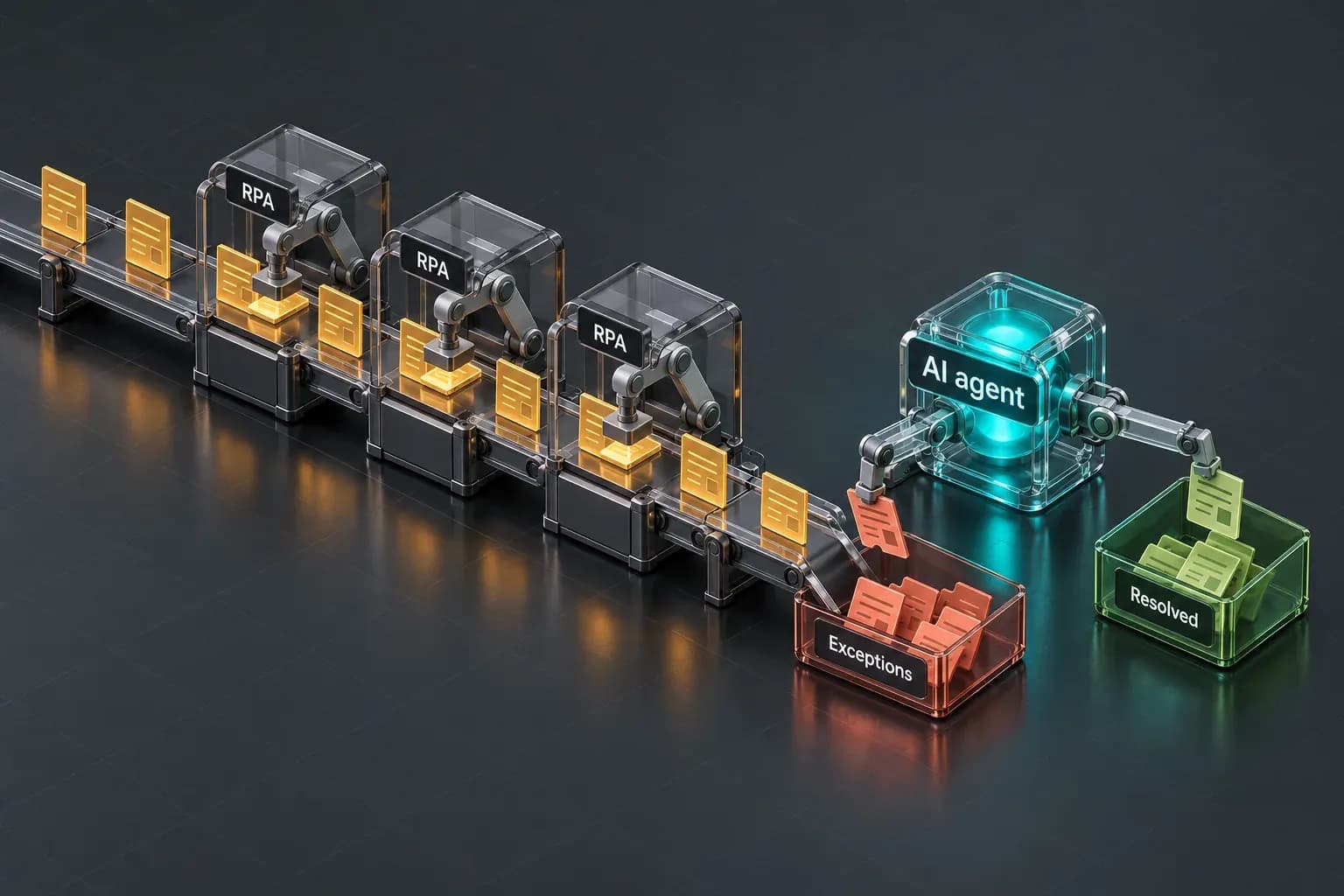
Robotic process automation removes the manual, repetitive keystrokes inside a business process: the copy-paste between systems, the same lookup repeated on every case, the same approval routed the same way every week. The direct benefits of robotic process automation are fewer manual errors, faster cycle times, a lower cost per transaction, and a clean audit trail of exactly what happened and when. The less obvious benefit is what it frees a team to do once the repetitive part of the job is no longer theirs.
What Robotic Process Automation Actually Automates
Robotic process automation (RPA) is software that follows a defined set of rules to complete a digital task the way a person currently does it: log in, read a field, copy a value, paste it somewhere else, check a condition, move to the next step. It operates inside the interfaces and systems a business already runs, rather than replacing them, which is why it is often the first automation a finance, HR, or operations team adopts.
That scope is also its boundary. Classic RPA is precise inside a fixed, rule-based path and brittle outside it: change the layout of a source screen, introduce a judgment call, or hand it an unstructured input, and it stops. Knowing that boundary is what separates a benefit list that holds up from one that overpromises.
The Core Benefits of Robotic Process Automation
- Fewer manual errors. A bot performs the same steps in the same order every time. It does not mistype a field, skip a step under deadline pressure, or apply yesterday's exception to today's case. Error rates on the automated path drop toward zero for the steps actually in scope.
- Faster cycle time. A task that took a person minutes because of context-switching, waiting for a screen to load, and manual lookups runs in a fraction of that time end to end, and it runs whenever the trigger fires, not only during business hours.
- Lower cost per transaction. Once a process is automated, the marginal cost of running it again approaches the cost of compute rather than the cost of a person's time, which is why finance, claims processing, and invoice matching are common first targets.
- A complete audit trail. Every action a bot takes is logged: what it read, what it changed, and when. That is a stronger compliance record than a person's memory of a judgment call made under deadline, and it is often the reason a regulated team adopts RPA before anything more autonomous.
- Scalability without headcount. Transaction volume spikes, a bot instance spins up to match it, and spins back down after. Scaling a manual process means scaling the team; scaling an automated one means adjusting a schedule.
- Time back for the work only a person can do. The strongest version of this benefit is not "fewer people," it is fewer people spending their day on copy-paste. The employee who used to reconcile the same report every Friday reviews the automated output and works the exceptions instead, which is a different, more valuable use of the same hour.
Where RPA Benefits Show Up First
The functions that see the benefit soonest share four traits: the process runs often enough that automation compounds, the logic is rule-based enough to define without ambiguity, the output is measurable on cost and cycle time, and the systems it touches are known and scoped. Invoice processing, employee onboarding paperwork, claims intake, data entry between systems that do not natively integrate, and routine compliance reporting all fit that profile, which is why they are the processes most RPA programs start with rather than an edge case chosen for novelty.
The processes that do not fit the profile are the ones with real judgment calls, unstructured inputs, or a source system that changes shape often. Automating those with classic RPA produces a brittle bot that breaks on the first exception, which is a maintenance cost, not a benefit.
Where RPA Benefits End and Agentic AI Extends Them
Classic RPA follows a fixed script. It does not read an unstructured document and decide what it means, does not choose between two valid paths based on context, and does not adjust when the source system's layout changes. That gap is exactly where agentic AI extends the same category of benefit into work RPA cannot reach: an agent can read an unstructured input, apply judgment inside a defined boundary, pull from multiple systems, and route the exception to a person only when it actually falls outside that boundary, rather than breaking silently.
Archon Workforce runs six specialist agents under one orchestration layer, built around exactly that handoff: the rule-based, repetitive steps run on their own, and anything that needs a judgment call or crosses a defined risk threshold queues for human approval before it executes, with an audit log of the decision path. Deployment is available on managed cloud, a private VPC, or fully on-premises, and the routing is model-agnostic rather than locked to a single provider. For the broader pattern of moving from one automated process to several running in production, see AI Workflow Automation: The Complete Guide for Business Teams.
Capturing the Benefits Without the Common Failure Modes
The RPA programs that keep their benefits over time share a few habits. They automate a whole workflow, not just the single step that was easiest to script, because a bot bolted onto one step in an otherwise manual chain still leaves the handoffs, the waiting, and the errors on either side of it untouched. They set a named owner for each automated process, because a bot with no owner is the first thing that breaks quietly and the last thing anyone notices broke. They build in monitoring from day one rather than after the first silent failure, since a bot that stops working without alerting anyone erodes the exact reliability the benefit case was built on. And they treat maintenance as a fixed, recurring cost of the source systems changing, not a one-time build: a bot that was not touched after go-live is a bot quietly waiting for the next layout change to fail on.
FAQ
What is robotic process automation (RPA)? RPA is software that automates a rule-based digital task by performing the same steps a person currently does inside existing systems and interfaces: logging in, reading data, applying a rule, and moving to the next step, without changing the underlying systems.
What is the single biggest benefit of RPA for a business? For most teams it is the combination of fewer manual errors and a complete audit trail: the process runs the same way every time and every action it takes is logged, which is why regulated, compliance-heavy functions are often the first to adopt it.
How is RPA different from AI agents? RPA follows a fixed, rule-based script and stops when it hits something outside that script. An AI agent can read unstructured input, apply judgment inside a defined boundary, and adjust its next step based on what it finds, which lets it handle work RPA cannot.
Do the benefits of RPA apply to smaller businesses, or only large enterprises? The benefit case depends on the process, not the size of the company: a small team running a high-volume, rule-based task, like invoice entry or onboarding paperwork, sees the same error-rate and cycle-time gains a larger enterprise sees on the same kind of process.
What limits the benefits of RPA in practice? Classic RPA is brittle outside its scripted path: a change to a source system's layout, an unstructured input, or a step that needs judgment will break a bot built on rules alone, which is why processes with real ambiguity need a governed agent rather than a script.
Most AI consulting stops at strategy. Archon builds the production system, governs it, and stays to operate it. Book a Consultation to talk through which processes are ready for RPA today and which need a governed agent instead.