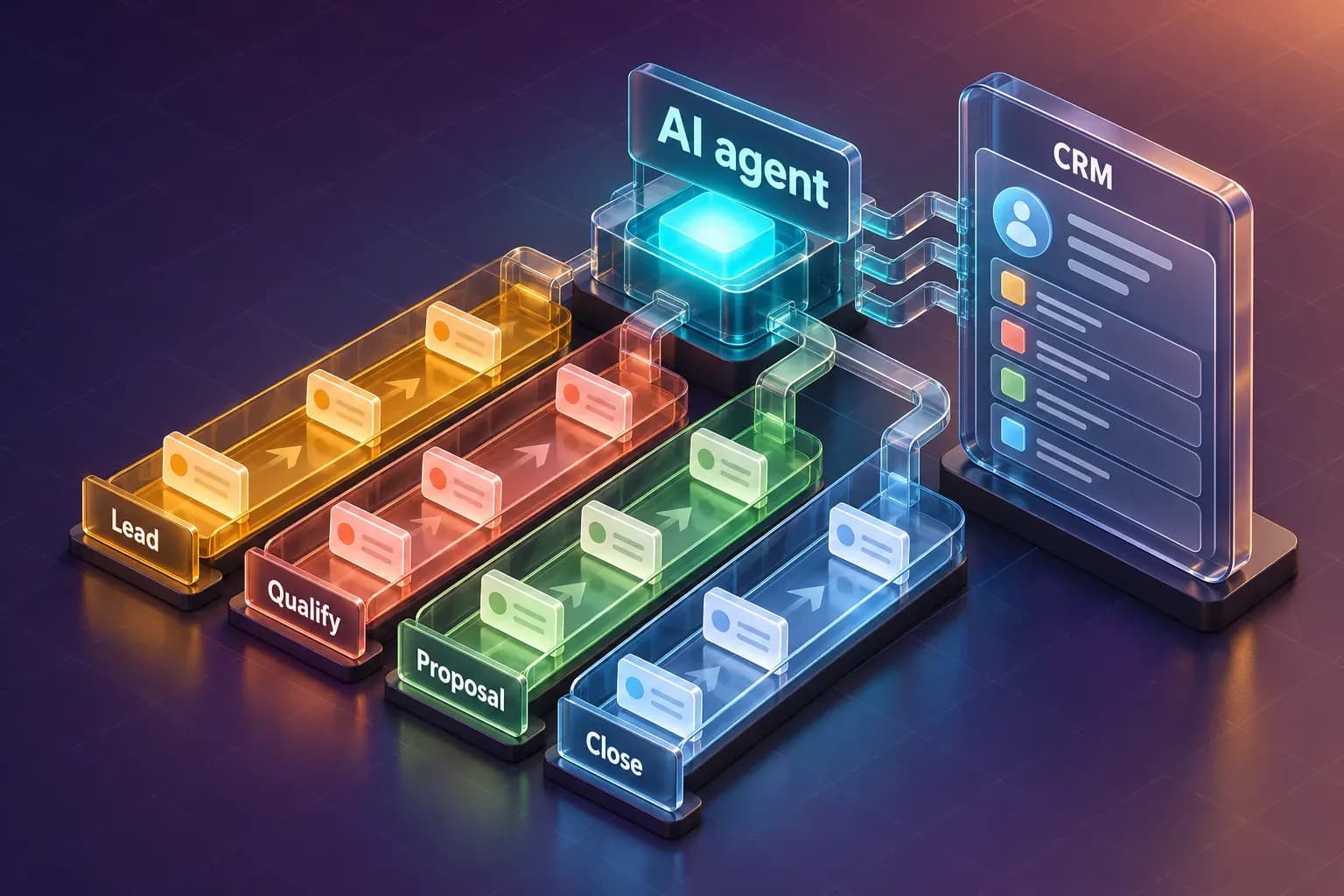
B2B sales software is the stack a business-to-business sales team runs its pipeline on: a CRM to hold the record, a sales engagement platform to run outreach, a configure-price-quote (CPQ) tool to price a deal correctly, and forecasting or revenue-intelligence software to tell leadership what is actually going to close. Increasingly it also includes an agentic layer that acts on that data instead of only displaying it. Here is what the category actually covers, where it stalls, and what to check before you sign a contract.
What "B2B Sales Software" Actually Covers
The term covers more ground than most vendor pitch decks suggest, and knowing the boundaries matters before an evaluation starts:
- CRM: the system of record for accounts, contacts, and deal stages. Everything else in the stack either writes to it or reads from it.
- Sales engagement platforms: sequence and track outbound, calls, emails, and the cadence between them.
- Configure-price-quote (CPQ): builds a compliant, correctly priced quote for a deal with more than one product, discount tier, or approval level.
- Forecasting and revenue intelligence: rolls pipeline activity into a number leadership can plan against, and flags deals that are at risk before the quarter closes.
- Contract and proposal software: turns an accepted quote into a signed agreement.
A vendor selling one of these five pieces will often talk about it as though it were the whole category. A buyer evaluating b2b sales software for a team is usually looking at some combination of the first three, with the last two added once the pipeline is large enough that a spreadsheet forecast stops being credible.
The Core Capabilities Worth Evaluating
Feature lists are long and mostly the same across vendors. The capabilities that actually separate a tool that gets used from one that gets abandoned after the pilot are narrower:
- Pipeline visibility that matches how the team actually sells. A tool built around a generic deal-stage model forces a team to reshape its process to fit the software, rather than the other way round. Check whether stages, fields, and approval steps can be configured to the real sales motion, not just relabeled.
- Data accuracy without manual upkeep. A CRM is only as good as what is actually in it. The software that earns adoption is the one that keeps the record current with the least manual typing, through activity capture, enrichment, and deduplication, not the one with the most dashboards.
- Forecasting that reflects what happened, not what a rep hopes happens. A forecast built from self-reported confidence scores is a survey of optimism. A forecast built from logged activity, deal age, and stage progression is closer to a measurement.
- Integration depth with the rest of the stack. Sales software that sits next to the CRM instead of inside it creates a second system of record, and a second system of record is where data quality goes to die.
- A real audit trail. Who touched a deal, what they changed, and when. This matters for forecasting integrity and, increasingly, for any AI capability layered on top of the tool.
Where Most B2B Sales Software Stalls
The common failure mode is not a missing feature. It is a workflow the software cannot actually finish on its own. A CRM shows that a deal has gone quiet; it does not draft the follow-up. A forecasting tool flags a stale opportunity; it does not update the stage once the rep confirms it slipped. A CPQ tool builds the quote; a person still has to notice the deal is ready for one.
That gap, between surfacing a problem and acting on it, is where most of the manual work in a sales org still lives. It is also the gap that static, rule-based software cannot close on its own, because the next step usually requires reading an unstructured input, a call transcript, an email reply, a Slack thread, and making a judgment call about what to do with it.
Where AI Agents Extend The Category
This is the layer that is newest to b2b sales software, and the one most worth evaluating carefully, because "AI-powered" now appears on nearly every vendor's homepage regardless of what the product actually does.
The useful distinction is between a feature that summarizes and a feature that acts. A summary saves a few minutes of reading. An agent that logs the call, updates the deal stage, drafts the follow-up, and flags the deal as at-risk, all from the same call, removes the task rather than compressing it. Archon Workforce runs six specialist agents under one orchestration layer, built around exactly that distinction between a task an agent can complete on its own and a decision that has to route to a person. Deployment runs on managed cloud, a private VPC, or fully on-premises, and the routing between models is model-agnostic by design rather than locked to one provider. For a closer look at what that looks like inside CRM and pipeline work specifically, see AI Sales Automation: Cut the Manual CRM Work.
The part worth being skeptical of is autonomy without a check. An agent that can silently change a deal stage, email a prospect, or overwrite a contact record is a liability the moment it infers wrong, and it will eventually infer wrong. The pattern that holds up in production is approval queues and audit trails: the agent prepares the action, and a person clears anything customer-facing, irreversible, or tied to a number leadership relies on. If a vendor cannot describe that boundary, that is itself worth noting during evaluation. For a wider view of what an agent platform actually is versus a chatbot with a new label, see What Is an AI Agent Platform?
A Buyer's Checklist Before You Sign
Before signing a contract for b2b sales software, roughly in the order it matters:
- Does it fit the actual sales motion, or does the team have to change how it sells to fit the tool?
- What does it automate versus what does it only display? A dashboard is not an outcome.
- If it includes an AI or agentic layer, what can it do without a human, and what requires approval first? Ask this directly; a vague answer is itself an answer.
- Where does customer and deal data go, and does the vendor use it to train a shared model or keep it scoped to your instance?
- What is the audit trail? Can you see exactly what changed, when, and at whose direction, human or agent?
- How does it integrate with the rest of the revenue stack, and does it become a second system of record or extend the one you already have?
- How is it priced, and does the pricing model scale with the outcome the team is buying, or with seats and tokens regardless of usage?
A tool that answers all seven clearly is worth a pilot. A tool that only answers the first two is a CRM with a marketing page.
FAQ
Is a CRM the same thing as b2b sales software? No. A CRM is one piece of b2b sales software, the system of record. The category also includes sales engagement, CPQ, forecasting, and, increasingly, the AI agents layered on top of that data.
What is the difference between AI-assisted sales software and an AI agent? AI-assisted software typically summarizes or suggests, and a person still does the work. An AI agent takes the action itself, such as logging the call or drafting the follow-up, within boundaries a person has approved.
Should a small sales team buy the same b2b sales software as an enterprise team? The capability that matters scales with pipeline complexity, not headcount. A small team running a simple, high-volume motion often needs less configuration than a large team selling multiple products through multiple approval layers.
What should disqualify a b2b sales software vendor during evaluation? An AI or agentic feature with no visible boundary on what it can do without a human, and no audit trail for what it already did.
Most AI consulting stops at strategy. Archon builds the production system, governs it, and stays to operate it. Book a Consultation to talk through what a governed AI layer would actually do inside your sales pipeline.