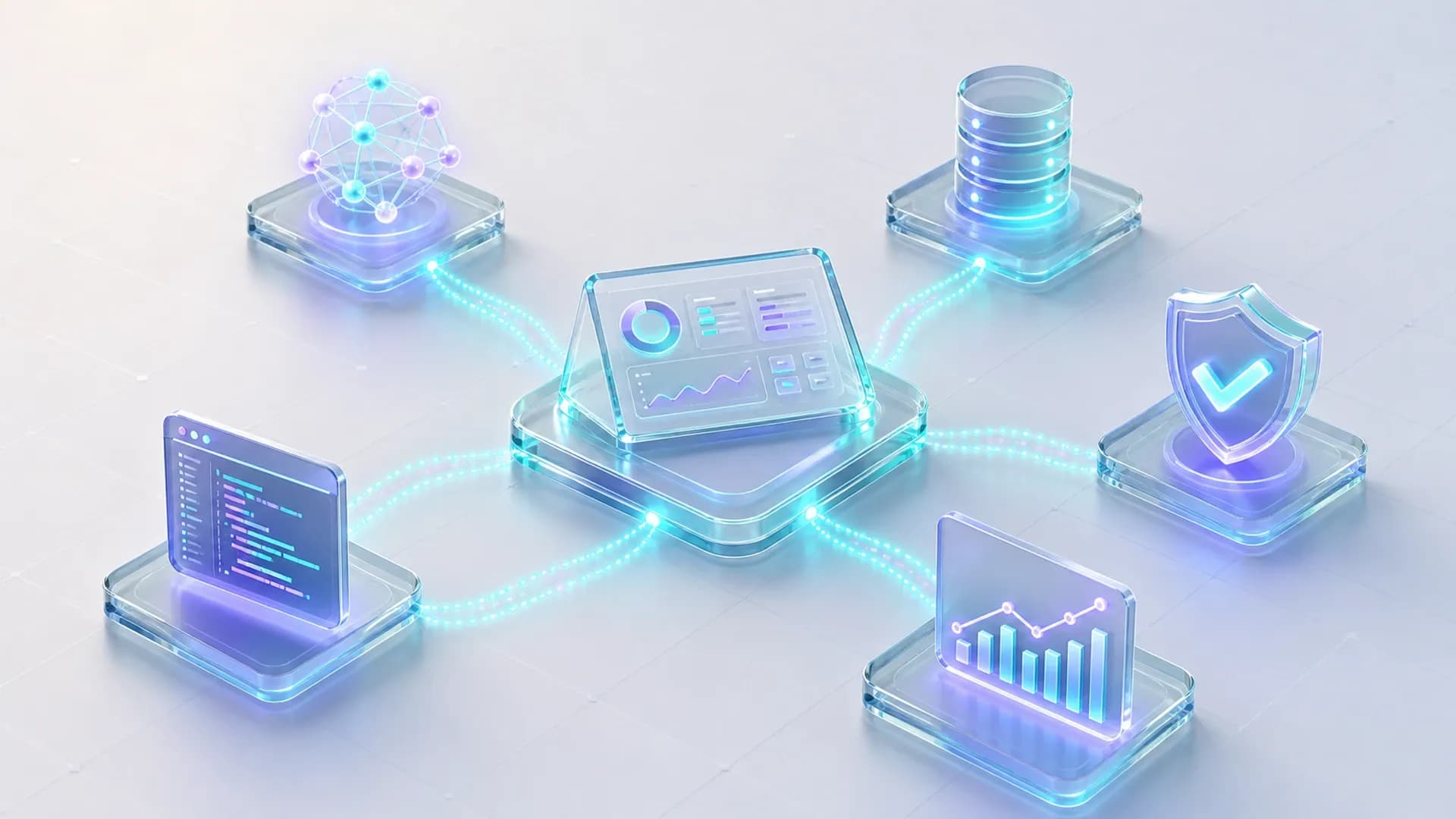
An AI agent platform is the operating layer an enterprise uses to build, govern, and run autonomous AI agents against real business work. It brings model reasoning, permissioned access to your data and systems, human approval, and orchestration into one place, so agents do not just answer questions, they complete tasks you can see and trust.
The definition, in plain terms
An AI agent platform is one system for creating, deploying, governing and operating AI agents. In practice that means every agent gets four things: its instructions, the tools and data it is allowed to touch, the guardrails on what it can do, and a record of everything it did. The agent itself is the part vendors demo. The other three are the part that decides whether it survives production.
It is worth being precise about what counts. Anthropic’s engineering team distinguishes workflows, where models and tools run through predefined code paths, from agents, where the model directs its own process and tool use, and OpenAI notes that an application which integrates a model but does not let it control execution is not an agent at all. A platform worth the name manages the second kind. The shift heading into 2026 is from chat to execution. The first wave of enterprise AI was a chat box: a person asked, a model answered, and the human did the work. An agent platform closes that loop. The agent reads the document, calls the system, applies the business rule, and routes the result for approval, as a managed step in a real workflow.
What separates a platform from a chatbot
- Reasoning and planning: the agent can hold a goal, break it into steps, and revise based on what actually happened, not just return one response.
- Permissioned access: scoped connections to the systems where work lives, such as CRM, ERP, ticketing, and file storage, with least-privilege by default.
- Explicit decision logic and human approval: sensitive actions route through an approval queue before they execute.
- Orchestration: multiple specialist agents coordinate on one outcome instead of one model trying to do everything.
- Visibility: tasks, token usage, deliverables, and status are all observable, not hidden inside a prompt.
Why an AI agent platform matters in 2026
Enterprises are moving pilots into production, and production has requirements a demo never had. The 2026 buyer criteria are concrete: zero-trust identity for every agent, compliance built into the design rather than bolted on, and orchestration that scales horizontally as more work moves onto agents. None of that lives in a standalone model. It lives in the platform around it.
Access to a model is not an operating model. The platform is where autonomous AI agents become accountable work.
Autonomous agents need a framework, not a free hand
The phrase autonomous AI agents scares governance teams for a good reason: autonomy without oversight is a liability. Agentic AI governance is the answer, and it is a runtime control plane rather than a policy document. A serious agent platform answers that with an AI agent framework of bounded permissions, approval paths for anything high impact, and an audit trail that shows who approved what and when. Speed and control are not a trade-off here. The framework is what lets you move fast safely.
What to ask before you buy one
- What exact work will the agents own each week, and how is the output measured?
- Which systems and data can each agent access, and at what privilege level?
- Where do sensitive actions stop for human approval before they run?
- How is token usage tracked against a commercial limit?
- Where can I see work in progress, and the record of what already shipped?
Sources
- Building effective agents, Anthropic Engineering
- A practical guide to building agents, OpenAI
See a managed AI agent platform in action
Archon runs a governed, multi-agent workforce against real business outcomes, with approvals and full visibility built in.
Explore the Archon workforce→