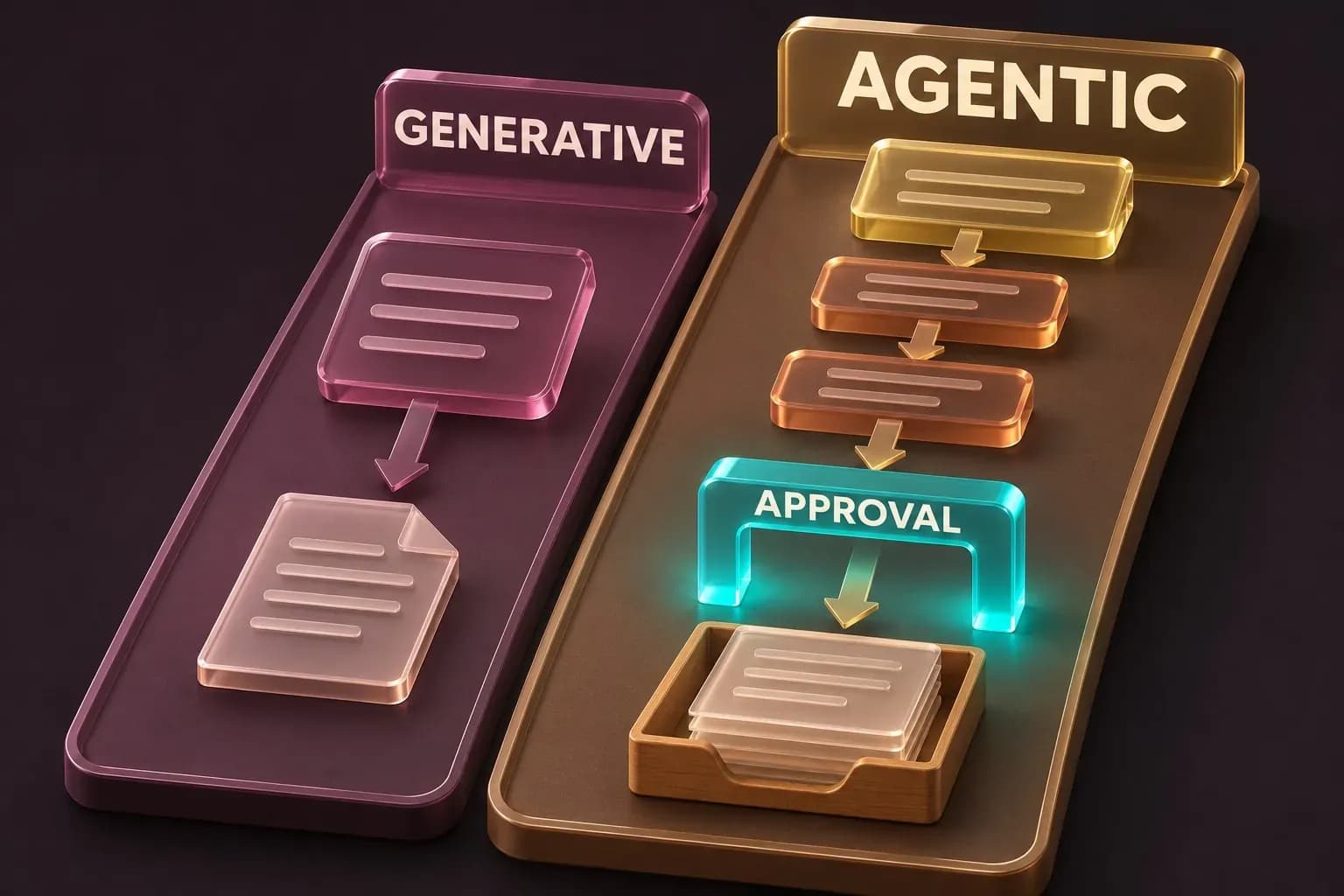
Agentic ai vs generative ai comes down to what happens after the output exists: generative AI produces content when asked and stops, while agentic AI takes a goal, plans the steps, uses tools and systems, and carries the work through to a result. A team buying for drafting, summarizing or ideation needs generative AI, and a team buying for work that touches CRMs, tickets, approvals and records needs agentic AI, which usually runs generative models inside it.
What generative AI does and where it stops
A generative model produces text, images, code or audio from a prompt. A person reads the output and decides what happens next. That last part defines the category: the model's job is finished when the output appears, and everything after that belongs to a human.
In practice that has a few consequences. The model has no access to your systems of record, so it cannot look up a customer, update a deal or file a ticket. It does not remember the task between sessions unless someone builds that memory around it. And a person carries every result to the next step, whether that means pasting a draft into a CMS, copying a summary into an email or retyping a suggested value into a form.
Generative AI is the right purchase when the work is the artifact itself:
- Drafting emails, briefs, product descriptions and first versions of documents
- Summarizing long threads, calls or reports
- First-pass analysis that an analyst will check and refine
- Creative variants, such as ten headline options or several image directions
Plenty of teams get all the value they need from this and never need more.
What agentic AI adds on top of a generative model
An agentic system takes a goal, breaks it into steps, calls tools and systems to carry them out, checks what came back and continues until the task is done or has to be handed to a person. The generative model is still in there, usually as the component that reasons about the next step and writes the text. What the agentic layer adds is the machinery around it:
- Planning. The system decides the order of steps instead of waiting for a prompt for each one.
- Tool and data access. It can read from and write to the CRM, the ticketing system, the calendar, the content platform.
- State across steps. It keeps track of what it has done, what it found and what is left.
- An exit condition or escalation path. It knows when the task is finished and when it should stop and ask a person.
Because the generative model sits inside the agentic system, the two are layers of the same stack and a buyer rarely has to choose one over the other. The real question is whether the work needs the layer around the model.
Two neighboring distinctions come up often. A fixed-rule automation also touches systems but follows a script that someone wrote in advance; workflow software versus AI agent workforces covers where that line falls. And a single agent differs from a team of agents that hand work to each other, which agents and multiagent systems works through.
Agentic AI vs generative AI side by side: the differences that change a buying decision
These are the dimensions that tend to change what you buy, how you set it up and who has to be involved.
- Trigger. Generative: a person writes a prompt. Agentic: a goal, a schedule or an event in another system, such as a new lead arriving.
- Scope of action. Generative: produces an output. Agentic: takes a sequence of actions, each of which can change something.
- Systems touched. Generative: usually none beyond the chat or editing window. Agentic: the CRM, the ticketing tool, the document store, the publishing platform, whatever the task runs through.
- Who approves. Generative: the person reading the output, every time. Agentic: depends on the design; routine steps can run on their own while consequential ones wait in an approval queue.
- Failure mode. Generative: a wrong paragraph that a reader catches before it goes anywhere. Agentic: a wrong action in a live system, such as a lead assigned to the wrong rep or a record overwritten, which may be found only after it has had effects.
- What you measure. Generative: quality and time saved per output. Agentic: completed tasks, escalation rate, error rate on actions taken, and the time a task spends waiting for a person.
- Cost driver. Generative: metered by usage. Agentic: usage as well, plus integration work, monitoring and someone who owns the outcomes.
The failure mode row is the one that should shape the project. A person reviewing a generative draft is the safety check. Once a system can act, that check has to be built in deliberately as permissions, approval steps and a record of what the system did, because nobody is reading every output anymore.
Which one a given task needs: a short decision test
Run the task through these questions:
- Does it end in a document, or in a change to a system?
- Does it need more than one tool or data source?
- Does it repeat often enough to justify building something around it?
- What does a wrong action cost, and how quickly would anyone notice?
- Who owns the result when it goes wrong?
Three examples show how the answers fall.
A policy summary for an executive ends in a document, needs no system access and is read by the person who asked for it. Generative AI is enough, and an agent would add cost and risk for nothing.
Lead routing with a CRM update is different. A new lead arrives, the system looks up the account, checks territory and capacity rules, assigns an owner, writes the record and notifies the rep. It touches several systems, repeats all day and a wrong assignment has a visible cost. That is agentic work, and the assignment rules belong in the system's permissions instead of a prompt.
A content brief that goes through review and publishing sits in between. The system researches, drafts, routes the draft to an editor, applies the requested changes and publishes after sign-off. It is agentic because it moves through tools and stages, and it keeps a human approval step because publishing is a visible action that is hard to take back.
If you want more worked cases, agentic AI use cases lists real examples and some that only look agentic.
What it takes to run agentic AI in production
A demo shows the model completing the task once, with a developer watching. Production adds everything that happens when nobody is watching: who may the system act as, which actions need a person's sign-off, where the record of what it did is kept, how someone notices it drifting, and which named person is responsible for the outcome.
The access model any agentic deployment should be built to has four parts: single sign-on so the system's identity maps to your directory, role-based access control so each agent can reach only what its task requires, approval queues for consequential actions, and audit logs that record each step. If a vendor cannot show you all four, the system is running on trust. Governed AI agents need approval queues and audit trails goes through how those fit together, and agentic AI governance as a control plane covers the wider structure.
Model routing is the other production question. Capability, price and availability across models change over time, so a system that can send each task to whichever model handles it best will age better than one wired to a single provider. That is the argument in why enterprise AI should be model agnostic.
Monitoring and ownership are the parts that get skipped most often. Someone has to read the escalation queue, review a sample of actions and decide when a rule needs to change. Budget for that person's time when you compare the cost of an agentic project with a generative tool.
How Archon runs agentic work for clients
Archon is a managed AI operations company: it builds and operates governed AI workforces. Archon Workforce is six specialist agents under one orchestration layer, and Archon runs it as a managed operation with approval queues so a person signs off on what moves. Details are on the Workforce page.
On deployment, the options are managed cloud, your private VPC, or fully on-premises, and the platform is model agnostic by design. Customer prompts, files, outputs and workspace data are not used to train foundation models. Access runs through SSO, RBAC, approval queues and audit logs. The security page has the wording. Workforce pricing is set around the scope of the work, and the pricing page has current plans.
For teams that want the production system designed with them, Archon's view is that consulting which ends at a strategy document leaves the hard part undone. The harder work is building the production system, governing it and staying to operate it, and that is how the AI consulting engagements are set up.
To talk through whether a task of yours needs generative AI or an agentic system, Book a Consultation.