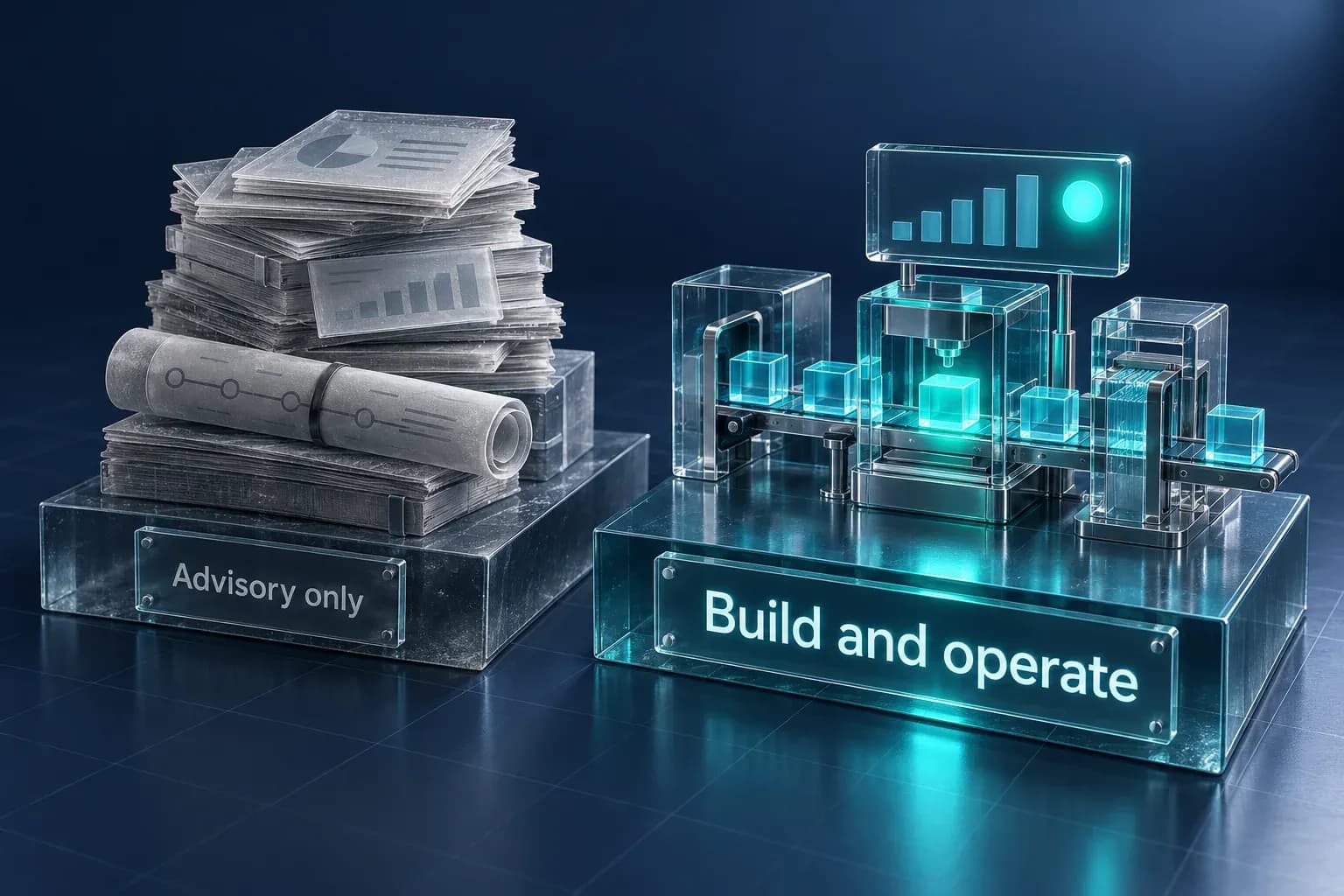
Digital transformation consulting services used to mean a roadmap: an assessment of where systems and processes lagged, a set of recommendations, and a handoff to the client's own team to build. Generative and agentic AI have changed what that engagement actually needs to deliver. The gap most buyers hit today isn't a shortage of recommendations, it's a shortage of firms willing to build the system, govern it, and stay to run it.
What digital transformation consulting services cover today
The scope has widened past the classic "cloud migration and process redesign" definition. A current digital transformation consulting engagement typically spans some mix of:
- Assessment and strategy — where AI and automation can change a workflow's outcome, not just its speed, and where it can't.
- System design and integration — connecting AI agents, automation, and existing software so work actually moves between them instead of stalling at a handoff.
- Governance and controls — approval thresholds, audit trails, and access rules for systems that now act on their own, not only systems a person operates.
- Deployment and change management — getting a new workflow into daily use, not just into a pilot that never leaves the sandbox.
- Ongoing operation — running, monitoring, and improving what was built after go-live, which is the piece a pure-advisory engagement was never built to include.
That last item is the one reshaping the category. A strategy deck was always the easy part.
Why the traditional consulting model is breaking on AI work
Classic strategy consulting is built around a deliverable: research, a set of slides, a recommendation, an exit. That model works when the client's own team can execute what's recommended. It works less well for AI and agentic systems, where the hard part isn't deciding what to build, it's operating something that makes decisions on its own, at volume, against real customer or financial data.
An advisory-only firm hands over a roadmap and leaves the operating model, the approval logic, and the monitoring to the client to invent. For a technology or operations leader evaluating digital transformation consulting services right now, that's the question worth asking before anything else: does this firm build and run the system, or does it stop at the recommendation?
Advisory-only vs. build-and-operate: the difference that decides outcomes
Most AI firms advise. Some sell tools. Archon operates the workforce. We are a managed AI operations company: we build and operate governed AI workforces for organizations that need real execution, not another tool to manage.
The distinction matters because the failure modes are different at each stage:
- Advisory-only firms are strong on assessment and weak on what happens after the recommendation lands. The client inherits the build, the governance design, and the ongoing operation with no vendor accountable for any of it.
- Tool vendors hand over software and leave the operating model, the integration work, and the judgment calls to the client's own team.
- Build-and-operate firms stay accountable for the system after it goes live: the approval queues, the audit trail, who can see what, and where the data runs.
Most AI consulting stops at strategy. We build the production system, govern it, and stay to operate it. That's the model behind Archon's AI Consulting practice: an Executive AI Diagnostic ($15K–$25K) to find where AI changes an outcome rather than just a task, a Production Deployment engagement ($75K–$250K+) to build and ship the system, and an Enterprise AI Program ($500K+) for a multi-workflow rollout across a larger organization — priced around the scope of work, not seats or tokens.
What to evaluate before you sign a digital transformation consulting engagement
A short list to bring to any proposal conversation, in the order that actually matters:
- Does the engagement end at a recommendation, or at a running system? Ask directly what happens in the 90 days after go-live and who is accountable for it.
- Where does approval sit? Any workflow that's sensitive, irreversible, or customer-facing needs a defined human checkpoint built into the design, not bolted on after an incident.
- What gets logged, and who can see it? SSO, RBAC, approval queues, and audit logs on every workflow are the baseline, not an upsell.
- Where does the data run, and is the model swappable? Managed cloud, a private VPC, or fully on-premises are different risk profiles, and a platform locked to one model vendor inherits that vendor's pricing and roadmap risk going forward.
- Who operates it after launch? If the answer is "your team," confirm that team actually has the capacity and the mandate to take it on, or the transformation stalls at exactly the point it needed to start paying off.
If the engagement is really about building an operating model for AI across the business rather than a single project, that's the conversation our AI Consulting practice is built around, and it's the same governance discipline covered in what actually controls an agentic AI system.
Red flags in a digital transformation consulting proposal
A few signals that a proposal is stronger on slides than on delivery:
- No mention of who operates the system after launch. If the statement of work ends at deployment, ask what happens next and who owns it.
- No governance section. A proposal for an AI-driven workflow that doesn't name approval thresholds, audit logging, or access controls hasn't designed the risk side of the system yet.
- A single-vendor lock on the underlying model, with no stated path to change it if pricing or performance shifts.
- Vague timelines with no defined first workflow. The 90-day plan for moving AI from pilot to production is the pattern that actually ships: prove one workflow end to end before extending to the next, not everything at once.
- Pricing that scales with seats or token usage rather than the scope of the work, which misaligns the vendor's incentives with the outcome you're paying for.
FAQ
What's the difference between digital transformation and AI transformation? Digital transformation historically meant moving systems and processes onto digital tools, cloud migration, process digitization. AI transformation is a subset of that work focused specifically on where AI and agentic systems can change a decision or an outcome, not just move data faster.
How much do digital transformation consulting services cost? It varies widely by scope. As one reference point, Archon's AI Consulting practice runs from an Executive AI Diagnostic at $15K–$25K, through Production Deployment engagements at $75K–$250K+, up to Enterprise AI Programs at $500K+, priced around the scope of work rather than headcount.
Should a digital transformation consulting firm also operate the system it builds? Not always, but it changes the incentive structure when it does. A firm accountable for operating what it builds has a direct reason to design real governance and a usable operating model, not just a working demo.
How long does a digital transformation consulting engagement take? It depends on how many systems and workflows are in scope, but the pattern that actually works is proving one workflow end to end before extending to adjacent ones, rather than attempting the full transformation at once.
Is a private deployment necessary for digital transformation consulting work? Not for every organization. Deployment options span managed cloud, a private VPC, or fully on-premises, and the right one depends on the sensitivity of the data and workflows involved, not a default setting.
Start with the operating model, not the roadmap
The recommendation was never the hard part of digital transformation. The hard part is building a system that makes decisions correctly, logging what it does, and staying accountable for it after the deck is closed. That's the line worth drawing between digital transformation consulting services that end at a strategy document and the ones that end at a governed system your team can actually run. If you're evaluating where AI changes an outcome in your own operation, book a consultation to walk through the workflow and what it would take to run it safely.