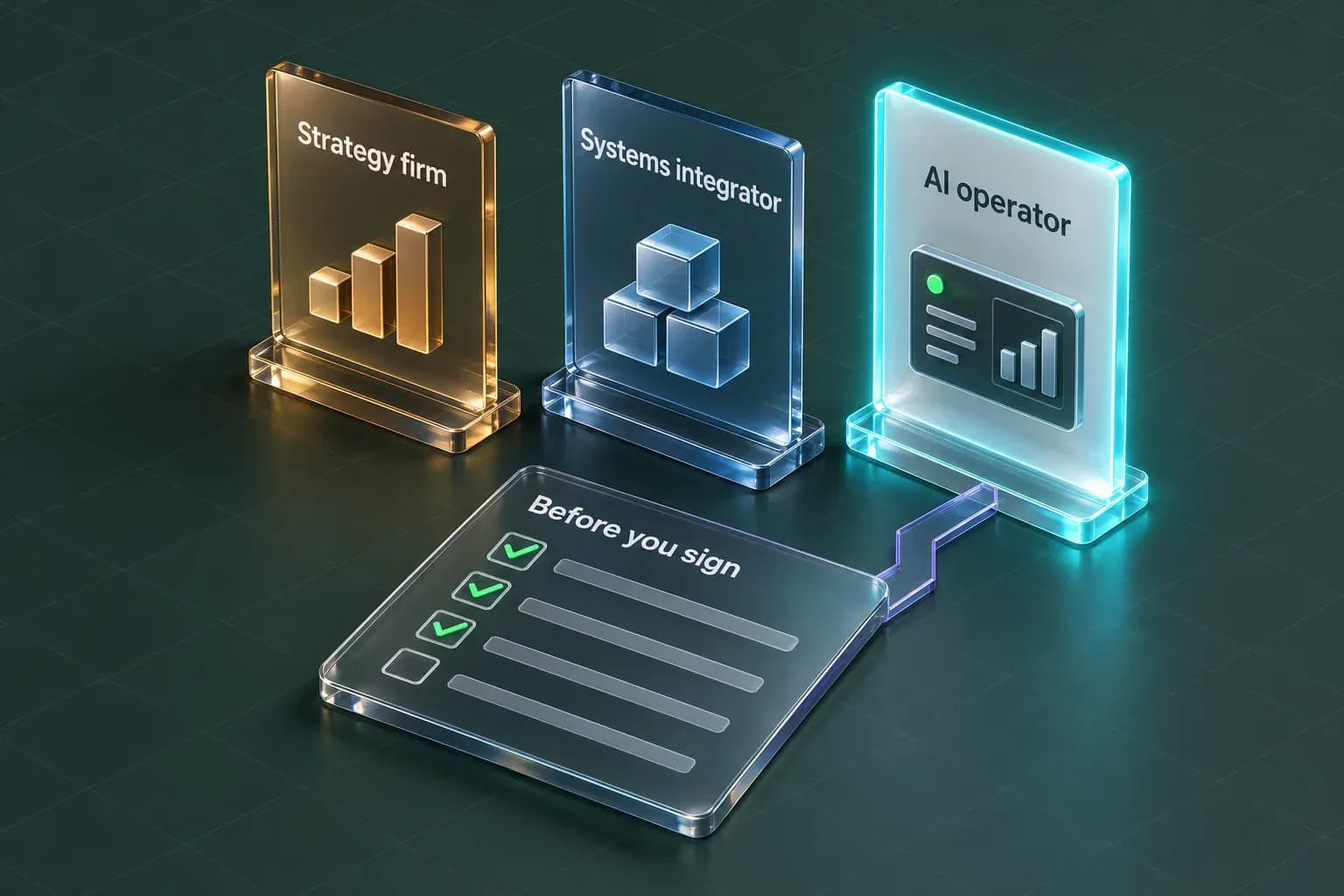
AI integration work is now crowded with three very different kinds of vendor wearing the same "AI consulting" label, and the difference matters more than any feature comparison on a pitch deck. This guide breaks down what separates the top software consulting firms for artificial intelligence integration from a strategy deck with an AI slide added to it: what production-grade integration actually requires, the checklist worth running before you sign anything, and the red flags that show up in almost every stalled engagement. The short version: the firm that matters is the one still operating the system after go-live, not the one that presented the roadmap.
The Three Types of Firms Competing for This Budget
Most proposals in this category come from one of three shapes, and knowing which one you are evaluating changes what questions matter.
- Global systems integrators. Broad benches, deep enterprise relationships, built for large multi-year modernization programs. AI integration gets folded into a wider scope, which usually means slower timelines and integration expertise that outpaces hands-on production AI experience.
- Boutique AI-native shops. Fast, technically sharp, often the team that ships the first working prototype. The risk shows up after go-live: the engagement ends on schedule, and there is no one left who knows the system well enough to operate it through its first real failure.
- Managed AI operations firms. Build the system, but stay attached to it. Governance, monitoring, and ongoing operation are part of the engagement from the start, not a separate line item someone has to negotiate later once the pilot works.
None of the three is wrong for every situation. The mistake is not knowing which one you actually hired until the contract is signed and the first production incident happens on a Friday night with no one on call.
What AI Integration Actually Requires From a Consulting Partner
"Integration" is doing a lot of work in that phrase, and it is worth being specific about what it covers before comparing firms on price.
- Production deployment competency, not a demo environment. A model that performs well in a sandbox and a model that performs reliably against live systems, real data quality, and real edge cases are different engineering problems, and a firm that has only solved the first one will discover the second one on your timeline.
- Connection to the systems you already run. The agent has to read from and write to the CRM, the ticketing system, the ERP, or whatever actually holds the business process, not a clean copy of it built for the pilot.
- A governance model, meaning an approval queue for consequential actions and an audit trail of what the system did and why, not a promise to "add that later." For what this looks like in practice, see our post on governed AI agents.
- Ongoing operation after launch. Someone has to own monitoring, retraining, and the response when the system encounters something it was not built for, for as long as the system runs, not just through the handoff meeting.
An Evaluation Checklist Before You Sign
Run each firm through the same six questions and compare answers side by side, not marketing language side by side.
- Where does it deploy? A real answer names managed cloud, your private VPC, or on-premises, by your choice, not theirs.
- Is it locked to one model provider? A real answer is no: routing is model-agnostic, chosen and changeable as the landscape shifts.
- What happens to your data? A real answer states in writing that it is not used to train the vendor's own models.
- What sits between a decision and an action? A real answer names an approval and audit mechanism, not "we will figure that out."
- Who operates this after go-live? A real answer names a team with a defined ongoing scope, not a one-time handoff.
- How is it priced? A real answer scopes the price to the work, with ongoing operation priced as ongoing work, not folded into a one-time project fee.
If a firm cannot answer the fifth question specifically, the rest of the proposal is describing a project, not a capability you will actually have running in six months. That distinction is also the whole argument for scoping AI work in phases rather than a single big-bang rollout; see the 90-day plan for moving AI from pilot to production for how that staging works in practice.
Red Flags That Separate a Delivery Partner From a Slide Deck
- No specific answer for "who operates this after we sign off" beyond "your team, with our documentation."
- A fixed, one-time project price for a system that will need ongoing governance and monitoring for as long as it runs.
- Locked to a single model vendor with no stated routing strategy for when a better or cheaper model becomes available. Model-agnostic architecture is not a nice-to-have on a multi-year system.
- Governance and audit controls mentioned only when you ask, not built into the proposal from the first draft.
- A roadmap with no production milestone on it, only sequential "phases" of strategy and discovery work.
Where a Managed AI Operations Model Fits
Most AI firms advise. Some sell tools. Archon operates the workforce. We are a managed AI operations company: we build and operate governed AI workforces for organizations that need real execution, not another tool to manage, and most AI consulting stops at strategy. We build the production system, govern it, and stay to operate it, which is the piece the checklist above is really asking about.
That means deployment on managed cloud, your private VPC, or fully on-premises, with routing that is model-agnostic by design rather than locked to one provider. Customer prompts, files, outputs, and workspace data are not used to train foundation models. Access runs through SSO, RBAC, approval queues, and audit logs, so a consequential action has a named check before it executes, not after. AI Consulting is priced around the scope of work, not seats or tokens; current figures are on the pricing page rather than repeated here, since they are the part most likely to be out of date the day after anyone quotes them.
The output-over-access argument for why this shape of engagement outperforms a one-time build is covered in our post on the managed AI workforce.
FAQ
What is the difference between a software consulting firm and an AI integration consulting firm? A general software consulting firm builds and integrates systems of any kind. An AI integration specialist does that work specifically for systems where a model is making decisions inside the process, which adds governance, model routing, and monitoring requirements a standard systems integration project does not have.
How long does AI integration take with a consulting partner? It depends entirely on scope, but the pattern that holds up is staged: a scoped pilot on one process first, then expansion once the governance and monitoring model is proven, rather than a single large rollout with no checkpoint.
Should you choose a fixed-price project or an ongoing managed engagement? That depends on whether the system needs to keep running and improving after launch. A one-time integration with a stable, narrow scope can work as a fixed-price project. Anything that needs monitoring, retraining, or governance over time needs an engagement priced for ongoing work, not a project fee that assumes the work ends at go-live.
Do these firms need access to production data? Usually yes, at some point, since a system that only ever saw sanitized test data will behave differently against real inputs. What matters is the firm's written policy on what happens to that data, whether it trains their own models, and what access controls sit around it before you grant it.
Book a Consultation to walk through which type of engagement actually matches what you need operating six months from now, not just what gets a pilot working next month.