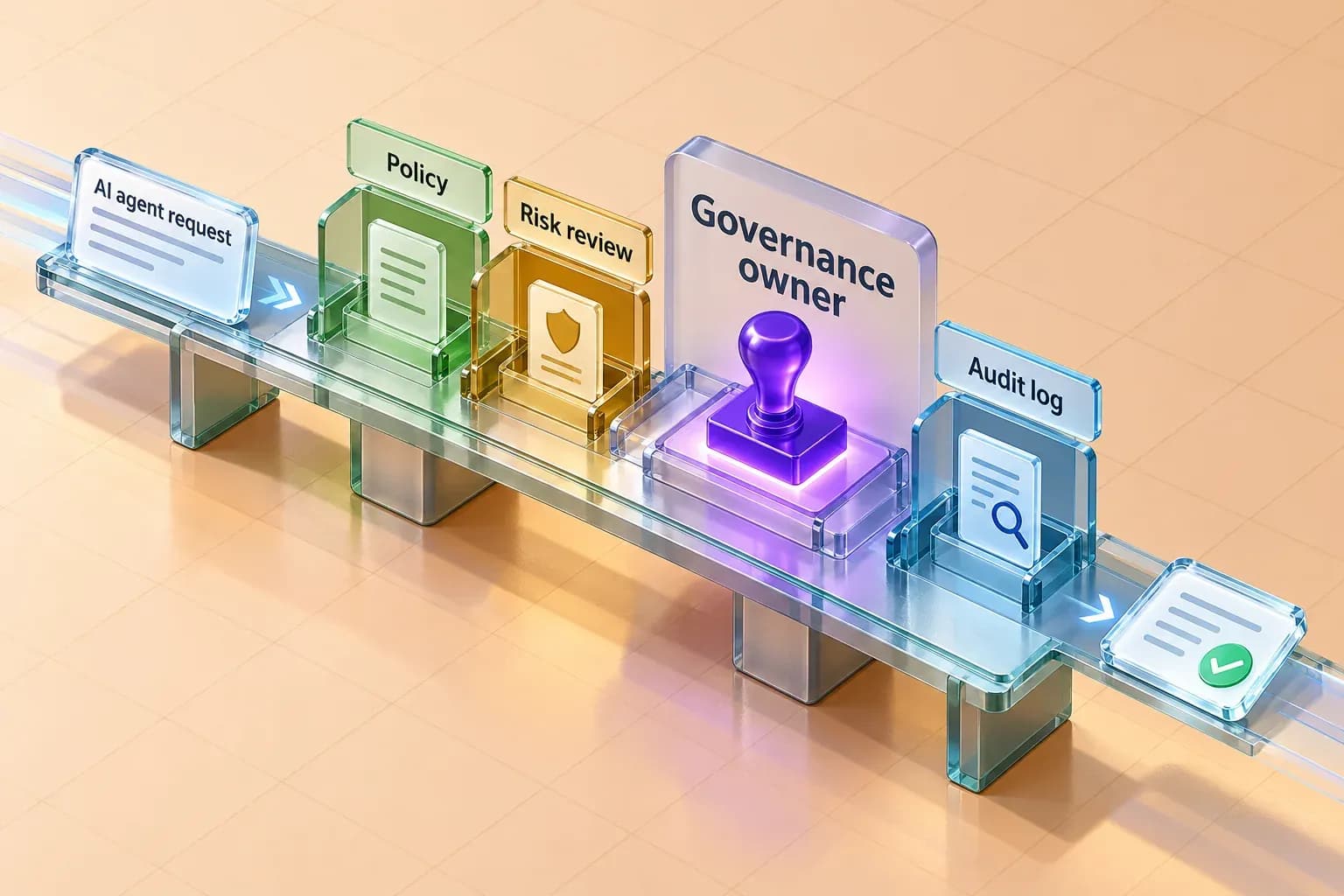
AI governance leadership is the answer to one specific question: when an agent does something wrong, who signs off on what happens next? Most organizations that struggle here do not lack a framework. They lack a named person with the authority to decide, and that gap is what this post is about, not the runtime controls themselves.
A Framework Names Controls. Leadership Names A Person.
Bring in a risk framework, publish an AI policy, run a workshop, and an organization can look governed while nothing about how agents actually operate has changed. A framework tells you what good controls look like: an approval gate before a sensitive action, an audit trail behind every run, scoped access instead of standing credentials. We covered what those controls are and how the major standards map onto them in our post on the agentic AI control plane.
None of that runs itself. A framework is a document. AI governance leadership is the role that turns it into a decision someone actually makes: where the approval threshold sits, who gets escalated to when an agent does something outside its known pattern, and who owns the answer when a customer, a regulator or a board member asks what an agent was allowed to do. An organization can have a complete framework and no governance leadership at all, and from the outside those two states look identical until an agent takes an action nobody expected.
What The Role Actually Owns
Strip away the title and the governance-leadership role has four concrete things to own, not a stack of policy documents:
- The agent inventory. Every agent running, what systems it can reach, and who is accountable for it. Without this, a governance program is reviewing a list it does not actually have.
- Where the approval line sits. Not every action needs a human in the loop, and reviewing everything trains people to click approve without reading. The leadership call is which actions are reversible enough to run unattended and which ones queue for a person first — the mechanics of that queue are covered in our post on approval queues and audit trails.
- The escalation path. What happens in the first hour after an agent does something outside its expected range. If that path does not exist before the incident, it gets improvised during one, which is the worst time to design a process.
- The review cadence. Agent permissions, approval thresholds and the inventory itself decay. Someone has to own making sure the list from six months ago still matches what is actually deployed today.
A governance leader who cannot point to a current answer on all four is holding a title, not running a program.
Where The Role Sits
There is no single correct home for AI governance leadership, and any post that tells you there is one answer for every company is guessing. What matters more than the org chart box is whether the person in it can actually decide something, not just recommend it.
Three shapes show up in practice. It sits inside an existing security or risk function, which works when that function already has the authority to say no to a business unit. It becomes a dedicated role, which makes sense once the agent count and the blast radius of what they touch grows past what a security team can hold as a side responsibility alongside everything else on its plate. Or it runs as a cross-functional committee of security, legal and the business owner of the agent, which works for setting policy but tends to stall as the decision-maker for a live incident, because a committee has to convene and an agent does not wait for a meeting.
The failure mode to avoid is naming governance leadership as a committee and nothing else. Policy can be set by a group. The moment an agent needs a yes or no on a specific action, someone specific has to be reachable to give it.
The Operating Rhythm
AI governance leadership is not a one-time exercise that produces a document and closes. It is a cadence:
- Weekly or per-incident: review anything that queued for approval and got escalated. Was the threshold right? Should this class of action move to unattended, or should a broader category start queuing?
- Monthly: review the agent inventory itself. What launched, what was decommissioned, and does every agent still have a named owner?
- Quarterly: revisit the approval thresholds and access scope wholesale, not just the exceptions that got escalated. This is the review that catches the agent nobody remembers granting broad access to, because nothing about it individually looked wrong in the moment.
That rhythm is what separates a governance program from a governance memo. A framework can sit on a shelf. A cadence has to be run by somebody, on a schedule, whether or not anything went wrong that week.
Leadership Decides Policy. The Platform Has To Enforce It.
None of the above works if the systems underneath cannot actually carry out the decision. If governance leadership decides a class of action should queue for approval, the platform running the agent has to be able to enforce that queue, not just document that it should exist. Archon Workforce is built with SSO, role-based access, approval queues and audit logs as part of the platform, not bolted on after deployment, so the leadership role has real controls to point the decision at rather than a policy nobody can verify is being followed. Read more on Archon's security model.
Most AI consulting stops at strategy: a report naming the risks and a framework to adopt, with no one accountable for running it afterward. Archon's Executive AI Diagnostic is built the other way, to leave an organization with a named owner and an operating model for that role, not just a document. See the current scope on the AI Consulting page, or book a consultation to talk through where the role should sit in your organization.
FAQ
Who should lead AI governance in an organization? Whoever already has the authority to make an operational risk call for the systems the agents touch, and can actually be reached to make it. That is often a security or risk leader already accountable for adjacent systems, not automatically a brand-new title.
Is AI governance leadership the same thing as having a framework? No. A framework describes what good controls look like. Leadership is the person accountable for where the approval threshold sits today, who gets escalated to, and whether the inventory review actually happened this quarter.
Do we need a dedicated AI governance leader, or can an existing role absorb it? It depends on scale. A handful of low-risk agents can usually sit inside an existing security or operations role as one more responsibility. Once the agent count and the blast radius of what they can reach grows, treating it as a side task is usually where the inventory goes stale first.
How often should the agent inventory and approval thresholds get reviewed? Anything escalated gets reviewed as it happens. The full inventory deserves a monthly look, and the thresholds themselves deserve a quarterly one, wholesale, not only the exceptions that got flagged along the way.
AI governance leadership is not a document you publish once. It is a named person, a short list of concrete ownership, and a cadence that keeps running after the framework is signed off.