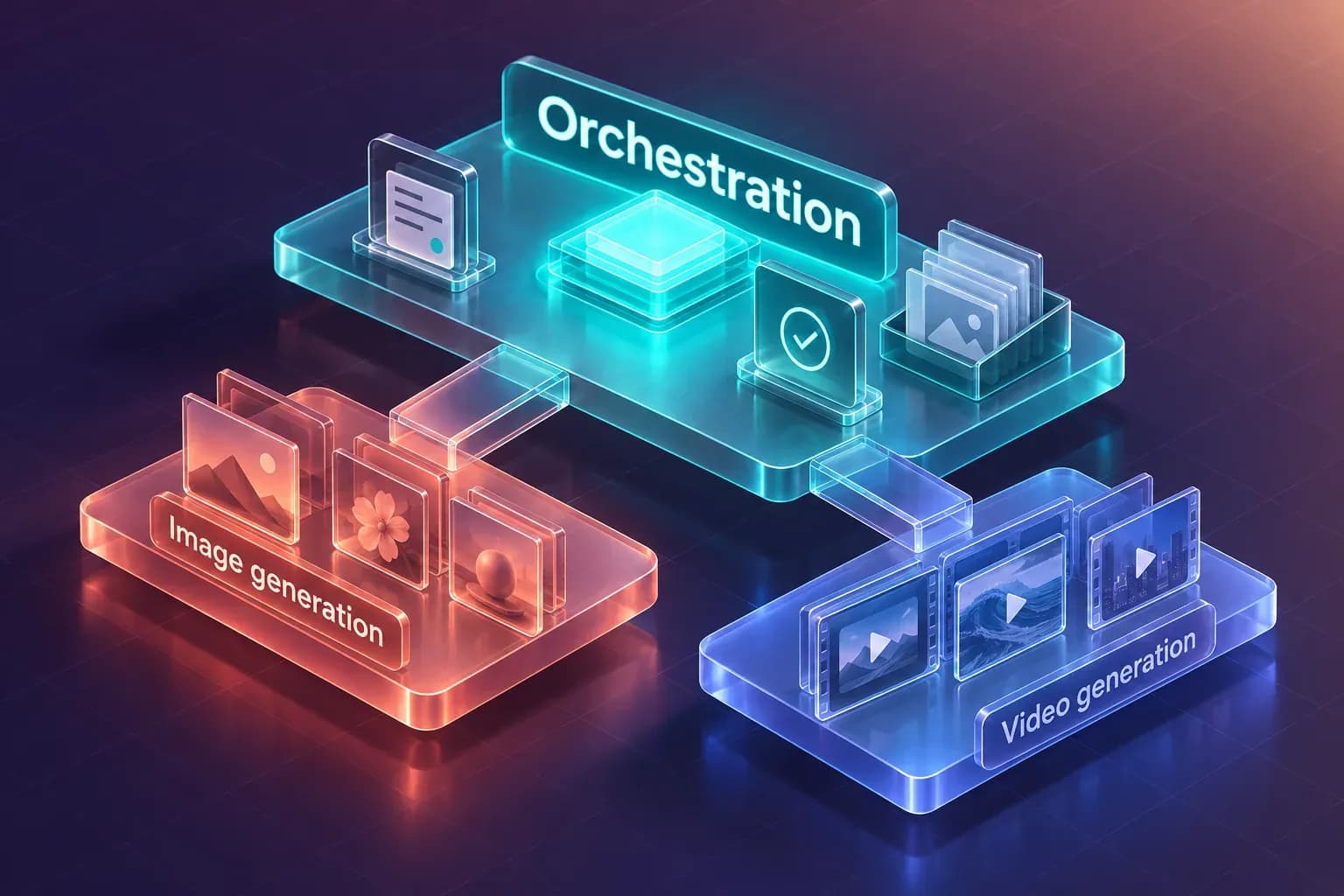
Archon Studio is not competing with Midjourney or Runway, and any comparison that ranks them against each other is making a category error. Midjourney generates stills. Runway generates and edits video. Archon Studio is the production layer above both: it routes each step of a job to whichever engine is strongest for it, holds the project context between steps, and puts the result through an approval flow. Choosing between them is not the question. Knowing which layer your bottleneck lives on is.
The three layers of an AI creative stack
A creative job that ships has three distinct problems to solve, and tools cluster around each one.
- Generation. Turning a prompt into a frame or a clip. This is what Midjourney does for stills and what Runway does for motion, and both are very good at it.
- Continuity. Keeping a character, environment, product or brand style identical across dozens of assets and revisions, which no single generation tool solves on its own because each generation is independent.
- Production. Sequencing steps into a repeatable pipeline, attaching the brief and brand context, routing approvals, and tracking cost and delivery. This is where agency work actually lives and dies.
Midjourney and Runway are excellent at layer one. Neither claims layer three. Archon Studio is built for layers two and three and is deliberately model-agnostic at layer one.
What Archon Studio, Midjourney and Runway are each for
Midjourney is strongest as a text-to-image generator with a distinctive aesthetic, best suited to moodboards, concept work, editorial illustration and ad stills where visual quality matters more than precise control. It also generates video, though as image-to-video animating a still rather than as a motion-first tool, so it anchors on the frame.
Runway is motion-first: a video generation and editing platform aimed at filmmakers and ad creatives who want directorial control, with a conventional timeline interface rather than a chat surface. It ships image generation and audio features too, but the centre of gravity is the moving image.
Archon Studio is a managed creative production workspace, currently a limited managed beta that BMI Studios configures and operates rather than a self-serve tool. One brief can move through image, video, voiceover and final edit, with Archon selecting the engine per step against live benchmarks for quality, consistency, speed and cost. Characters, products, styles and environments keep identity across assets and revisions. Projects, references, approved outputs and brand kits live in one place, so context does not get rebuilt in every prompt. Provider keys sit in an encrypted vault, and sensitive work can stay on local hardware or route only to approved providers.
The operator view from running client work through it
BMI Studios builds and operates Archon, and runs client creative production through Archon Studio rather than through a folder of separate tool subscriptions. The reason is not generation quality, which is largely a function of whichever frontier model is current this quarter. It is that a campaign is thirty assets that have to look like they came from the same place, survive two rounds of client revisions, and arrive with an audit trail of what was approved.
Three failure modes drove the design. Model churn, where the best engine for a step changes every few months and a workflow hardwired to one vendor ages badly. Context loss, where the brand guide and the approved direction live in a chat history nobody can search by week three. And approval sprawl, where the version a client signed off is a link in an email thread. A production layer exists to absorb all three, which is the same argument we make for a model-agnostic enterprise AI stack more broadly.
How to choose
If you need striking stills and you are one person or a small team, Midjourney is the right tool and a production layer is overhead you do not need yet. If your work is primarily motion and you want frame-level directorial control, Runway is the right tool for the same reason.
If your problem is that ten assets need to match, three people need to approve them, the brief keeps changing and nobody can say what a campaign cost to produce, that is a production problem and no generation tool will solve it. In that case the generation engine is an implementation detail, which is exactly why Archon treats it as one. The full picture of the workspace is on the Archon Creative Studio page, and the operating model behind it is covered in our note on a managed AI workforce delivering output rather than access.
See the creative production layer
Every major engine, one workspace, with continuity and approvals built in. See how Archon Creative Studio runs a campaign end to end.
Explore Archon Creative Studio→