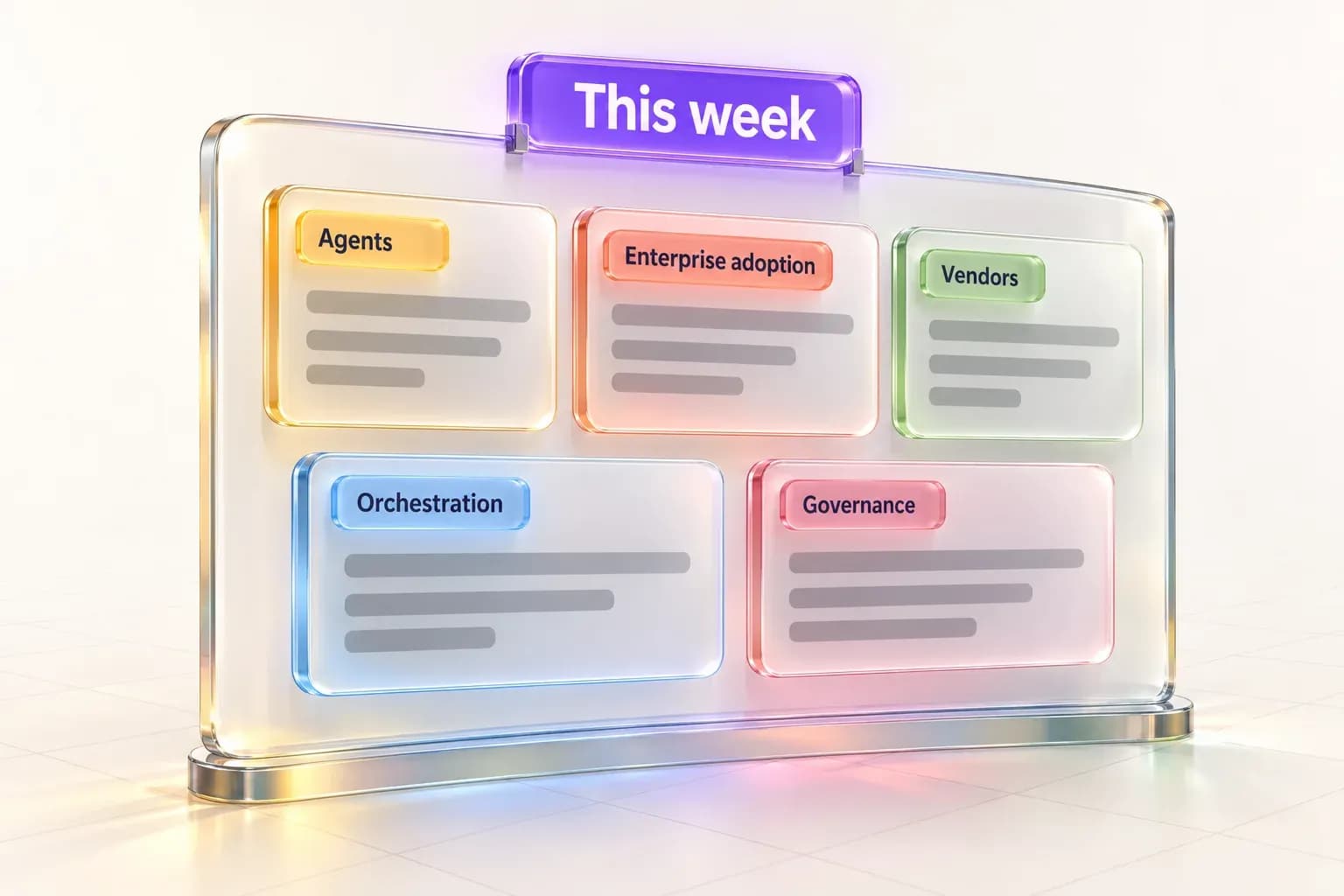
Most of what gets labeled "agentic AI news" is a product announcement with a new word attached to an old workflow. The real shift is smaller in headline count and larger in consequence: software is moving from answering questions to taking actions, on its own initiative, inside systems that used to require a person's hands. That shift is what enterprise teams actually need to track, not the weekly release cycle.
What "Agentic AI News" Actually Means
Search for "agentic AI news" and most results split into two piles: vendor announcements (a new model, a new framework, a new benchmark) and explainer content repeating the same definition. Neither answers the question a buyer or operator is actually asking, which is closer to: is this technology ready to run part of my business, and what changed that makes this a different conversation than it was a year ago?
An agent, in the working definition most of the industry has converged on, is a system that can plan a sequence of steps toward a goal, call tools or APIs to carry them out, observe the result, and adjust, without a human approving each individual step. A chatbot answers. An agent acts. That distinction is the actual news, and it is a capability shift, not a single event with a press release attached to it.
From Chatbots to Agents: The Real Shift
The last generation of AI deployments mostly stopped at the interface. A model answered a question, drafted a document, or summarized a thread, and a person decided what happened next. That pattern was safe by construction: the AI never touched a live system, so the worst outcome was a bad draft.
Agentic systems remove that stop. An agent that handles customer support might read a ticket, check an order status in a live system, issue a refund, and close the ticket, all without a person in the loop for a routine case. An agent that handles sales operations might update a CRM record, trigger a follow-up sequence, and flag an exception for a human only when something falls outside its defined boundaries.
That is a meaningfully different risk profile than a chatbot, and it is why the more useful agentic AI coverage right now is about governance and control, not capability demos. The interesting question stopped being "can it do the task" a while ago. It is "can it be trusted to do the task unsupervised, and can that trust be verified after the fact."
Where the Real Movement Is Happening
Three areas carry more of the actual change than any single model release does.
Orchestration, not single agents. A single agent doing one task well is a demo. The systems moving into production coordinate several specialist agents under one layer, each responsible for a narrower job, with the orchestration layer routing work, managing handoffs, and holding the shared context. This is closer to how a well-run team is structured than to a single very capable individual, and it is why "multi-agent" has displaced "AI agent" as the more accurate phrase for what enterprise deployments actually look like.
Model-agnostic routing. Teams that bet their entire agentic stack on one model provider found out how expensive that bet was the first time pricing, capability, or availability shifted underneath them. The more durable pattern is routing different tasks to different models based on what each is actually good at and what each costs, with the orchestration layer making that decision rather than a person hard-coding it. This also matters for governance: a system that can swap models is a system that is not locked into one vendor's data-handling terms by accident.
Approval queues and audit trails, not blanket autonomy. The systems that are actually running in production today are not fully autonomous in the sense the phrase implies. They have defined boundaries: routine, low-risk actions execute without a person, and anything outside those boundaries queues for human approval before it executes, with a record of what happened and why. That is the difference between "agentic AI" as a demo and agentic AI as something a compliance team will sign off on.
How Enterprises Are Adopting Agentic AI in Practice
The pattern that shows up repeatedly in how organizations actually roll this out has three stages, and skipping one is the most common reason a pilot never reaches production.
First, a narrow, well-bounded task. Not "automate customer service," but "handle the subset of support tickets that only require checking an order status and issuing a standard response." A narrow scope makes both the failure modes and the success criteria concrete.
Second, a defined approval boundary. What can the agent do without a person, and what requires sign-off. This is a governance decision before it is a technical one, and it needs to be made explicitly rather than discovered when something goes wrong.
Third, measurement against the actual baseline, not against the demo. The relevant question is not "did the agent complete the task" in a controlled test. It is whether the task got done correctly, on the same timeline, at the same or lower cost, across the real volume and variety of cases the business actually sees, with a clear record of what the agent did and why.
Archon Agents is a managed AI operations company, and the work is built around exactly that sequence: an operations or technology leader defines the scope and the approval boundary, and the system is built, governed, and operated to hold to it rather than handed over as a black box. Archon Workforce runs six specialist agents under one orchestration layer, with the routing, approval queues, and model-agnostic infrastructure described above built in rather than bolted on afterward, and deployment available on managed cloud, a private VPC, or fully on-premises depending on what the organization's data policy requires. For a closer look at what that governance layer actually needs to include, see Agentic AI Governance Is a Control Plane, Not a Policy Document; for concrete examples of the narrow-task pattern below, see Agentic AI Use Cases: 12 Real Examples and 3 That Are Not.
What to Look for When Evaluating an Agentic AI Vendor
A short list worth checking before any agentic AI tool touches a live system:
- Can you see the approval boundary, not just the output? A vendor should be able to show you exactly which actions execute automatically and which require sign-off, and let you change that boundary yourself.
- Is there an audit trail for every action the agent took, not just the final result? If an agent issues a refund or updates a record, there should be a record of the decision path, retrievable after the fact.
- Is the system locked to one model? A hard dependency on a single model provider is a business continuity question as much as a technical one.
- Does the vendor stop at strategy, or actually build and operate the system? Most AI consulting stops at a recommendation document. The harder and more useful work is building the production system, governing it, and staying to operate it.
- What happens to your data? Ask directly whether prompts, files, and outputs are used to train the vendor's models, and get the answer in writing.
None of these questions require deep technical expertise to ask. They require treating an agentic system the way any operations leader would treat a new hire with access to production systems: define the boundaries first, verify the work after.
FAQ
Is agentic AI the same thing as a chatbot with more features? No. A chatbot responds inside a conversation. An agent plans a sequence of steps, calls tools or systems to carry them out, and adjusts based on what happens, generally without a person approving each step along the way. The distinction is action versus response.
Is agentic AI safe to run without a person watching every action? The production systems that are actually working set a defined boundary: routine, low-risk actions run without a person, and anything outside that boundary queues for approval. "Fully autonomous with no boundary at all" is closer to a demo than a deployment most organizations should run.
What's the difference between agentic AI and generative AI? Generative AI produces content, a draft, an image, a summary. Agentic AI takes that further by acting on a goal across multiple steps, using tools and systems to do it, and adjusting along the way. Generative AI is often one of the capabilities an agent uses, not a separate category competing with it.
Do I need a different model for every agentic AI task? Not necessarily, but locking an entire agentic system to a single model provider is a common and avoidable risk. Model-agnostic routing, where different tasks go to whichever model handles them best, is the more durable pattern.
How long does it take to move an agentic AI pilot into production? It depends heavily on the boundary of the task and how well-defined the approval process is going in. Narrow, well-bounded tasks with a clear approval structure move faster than broad, loosely scoped ones, which is exactly why starting narrow is the pattern that repeats across working deployments.
Most AI firms advise. Some sell tools. The organizations getting real value from agentic AI right now are the ones that treated it as an operations problem from the start: a defined scope, a defined approval boundary, and a system built to be governed rather than trusted blindly. Book a Consultation to talk through where agentic AI actually fits in your operation.